Sunday, March 22, 2009

Silver Bullet?

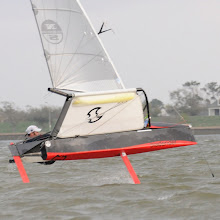
Moth front and center at North's Headquarters

Great start for the North Sail's International Moth program. Our V7 and V8 designs have been used in only three championships to date. In each of these three events only one sailor has used the North Sail for the entire event. However, in each of these events the lone sailor with a North Sail convincingly won the regatta:

2009 Australian Championships- 1st Place Nathan Outteridge (North Sails V7 MH)

2009 US Midwinter Championships- 1st Place Chris Williams (North Sails V7 MH)

2009 Victorian State Championships- 1st Place Rohan Veal (North Sails V8)

This past weekend at the Vic States Rohan raced with the new V8 design. Rob Gough from Tasmania also used a North V8 in the first two races, taking a 1st and a 2nd with the sail before heading back to Tasmania. Both Rohan and Rob were using new Bladerider VRX's which have been immaculately constructed. Rohan was using Bladerider spars and Rob was racing with a CST 353 mast.

These two new V8 sails were having a slight problem keeping the cams rotated, we are looking at a couple different details to solve this problem (Changing battens stiffness, stronger luff sleeve material and revised orientation, batten angles, etc). I am sure both Rob and Rohan would have been even faster with sails that had better cam rotation. Once the sails are 100% we will be starting our first production run of about 50 units.

The first batch of Southern Spars masts and booms have been shipped out. A few of these rigs will be tested in Hawaii as well as the first North Sails V10 design.

Winning equation for everyone to think about: Bladerider + North Sail = Silver Bullet

What's on YOUR mast?


Wednesday, March 18, 2009

Southern Spars

MemBrain Model of Southern Moth Rig


I always enjoy working with Sparmakers, it was one of my favorite parts of the AC design and luckily a very large part of North Sails Design Services work.

One of the things I find fascinating with mast analysis is that simulations can be checked with hand calculations pretty easily. This is something which is not possible with sail design, maybe this is one of the reasons that sail design still is very much a mix of art and science where mastmaking, while still a very creative process, is a pure engineering exercise.

Working with Southern Spars is always great, they have more engineers in-house than most of the other mastmakers combined (I don't think that is an exaggeration)! So there are always new tricks to learn. As everyone will soon know (Or should have figured out by reading the sail selection chart) the new Southern Rigs are a little stiffer than most other moth rigs.

Right now we are developing the V6 and V10 designs. North Sails Cape Town has built a lot of test sails so far for the Moth, so it was important to try to model the Southern Rig carefully to get the luff curve perfect in order to keep our prices affordable. Therefore a lot of homework was done to hopefully get the V6 and V10 designs perfect on the 1st couple prototypes.

The above graph is the measured deflection and predicted deflection of the CST 351 tubes. This test was required to calculate the EI's (Stiffness and Stiffness distribution) of the most common skinny mast.

Two Southern Spars tubes are being offered, the Standard P1 tube and the Phat Boy tube for sailors above 85kg or so. The theory is that larger sailors apply more force through greater Righting Moment and therefore force masts to bend more than a smaller sailor.

Therefore it is possible to design two different stiffness masts which will bend the same if a more powerful sailor is using the stiffer mast. This is critical for North Sails because by understanding this relationship we can make a mainsail design which should work for both rigs as long as sailors choose a rig which is appropriate for their size and fitness. This also gives larger sailors a more level playing field as they will not loose as much power through added mastbend than the average mothie.


The chart above shows the total mast deflection of a CST 351, Southern Spars P1 and Southern Spars Phat Boy rigs. Also shown is the Southern Phat boy rig with an additional 10% more downhaul which is a good measure of the added mastbend the stronger sailors can exert on the mast (Mostly through side bend) than the average mothie.

Side Bend of spars modeled in MemBrain


Fore/Aft predicted bends

Please feel free to contact me if you are interested in a Southern Spar for your Moth and I will put you in contact with your closest Southern dealer. Prices and info on the Southern Spars Element C6 micro carbon rigging to follow...

Friday, March 6, 2009

Moth Midwinters

Just back this week from the Moth Midwinters (20 hour drive down and 30 hour ride back home through a snow storm). We had a small fleet (Only 3 Boats) but had a great three days practice before the regatta where we all were able to try some new things. Most importantly for myself, I was able to try the V7MH design which is the same sail that Nathan won the Australian Nationals with. The sail setup great on my CST 352 rig, but I am looking forward to giving it a try on the Southern Spar as soon as it arrives.

In other news, the 1st batch of V8 sails left for AUS, although they just missed delivery for the Adelaide International Regatta. Hopefully we will have news to report on the new designs next week. We will then go straight into production of the V6 and V10 designs.
Also note that there are two V7 AP designs left for sale. Please drop me a note if you are interested. One sail is unused and the other only used three times. These would be good sails for larger or stronger sailors with a standard bladerider rig, Fastacraft Mast, C-Tech or a CST 351 mast.

Details will be announced for the Volvo Ocean Race Moth Expedition regatta in Boston next week. Posibility of a dozen boats making it the biggest event on the East Coast to date.
Enjoy the pictures from testing before the midwinters. As always, hospitality in New Orleans was once again amazing. Next years regatta will be Feb 17-20th.


Saturday, February 14, 2009

Sail Model Guide

Overlay of the V6, V8 & V10 mainsail designs, note similar mold shape

In the latest Mothcast Bruce McLeod and Luka Damic raised the point that the new North Sails V-Series of models is a bit confusing (Thanks for pointing this out!). Obviously our intention was not to confuse the market, so I have tried to clarify things for potential customers. (By the way, if anyone ever has questions, please feel free to send me an email: chris at design dot northsails dot com.)

Concept- As stated before our concept and North Sail's philosophy is always to offer only the highest quality and fastest sails possible. After months of research and testing, we concluded that due to the range in rig stiffness and sailor sizes that a single sail design will never be able to compete against sails which are more optimized for a specific mast. Furthermore we we did not want to force our clients to buy a mast to match our sail design (Similar to what is done with windsurf sails).

Therefore we identified a range of luff curves for the various moth masts and then modified the sail designs to suite these masts. The V6 design therefore has 10mm more luff curve than the V8 and the V8 has 10mm more luff curve than the V10 design.

By tailoring a design to a specific range of mast stiffness we can then adjust the head width and sail shape. For example, a stiffer mast can support more girth in the top easier- which is easy to accomplish with the area saved by taking out a little luff curve.

See the image below to understand the effect of luff curve on the head width:

Similarly a sail design optimized for a softer mast needs to be slightly finer in the molded shape in the front to prevent the sail from being too draft forward in lighter conditions. This effect can be seen in the image below:


Further optimization- In a perfect world our lighter clients will sail with slightly softer masts than our heavier clients. Therefore lighter sailors would end up using the V6 design and heavier sailors using the V10 design. However, as one can see in the images, the sails are not radically different from each other. A rider who wants to have a more customized quiver of designs may end up with a V10 design for lighter conditions and a V8 sail or stronger winds. This would allow the V10 sail to setup with less downhaul in light winds for a given sail depth. We will continue testing these concepts as time goes by and can help our clients decide what is the best designs for their needs.

Over the next couple weeks we will be testing different mast/sail combos and we will give our suggested setup once we have more data.


Monday, February 9, 2009

Cloth Matters

X-ply monofilm (left) vs. ODL04 (right) used in the V-Series North Moth Sails

Instron Testing ODL04 at nearly 100kg

Instron Testing X-Ply (Fill test shown, warp, fill and bias are tested)

In sailmaking the shape and design of a sail are very closely related to the cloth used in a sail. Likewise the performance of a sail has a lot to do with the cloth it is made from, which is why we feel it is important to use cloth that costs 3 times more than film.

Below are the results from tests this week of standard X-ply monofilm vs. ODL04 Technora used in the V-series Moth Sails. It is not surprising to us that the ODL04 is 1.39 times more resistant to stretch in the warp at 1% strain even though it only weighs 56% the weight of monofilm. With sailcloth the old saying, you get what you pay for is very true.


ODL04 1mil film results.

Smaller Stretch numbers are better, larger Loat at 1% strain are better


X-Ply test graphs

Tuesday, February 3, 2009

Sail Sale

North Sails and Bladerider are offering a sail sale to introduce the North V8 Moth mainsail. Buy two mainsails with the carbon batten upgrade and receive 20% off retail (Team up with a buddy and save some cash)! Contact your nearest North Sails loft or click here.

The big question lately is, "What is the different about the North mainsail?" The original concept of the North Sail was to have a powerful design which made tacking, gybeing, starting, etc easier. However, over the last several iterations of the design, the shape has evolved to a sail which has greater top end speed potential through flatter sections and good takeoff power with an improved twist profile. As you can see in the image below, the sail is straighter in the back for low drag when foiling and has a tight mid leech for improved upwind pointing and early foiling.


North Sails philosophy has been simple for the past 50 years. Build the highest quality, best engineered and fastest sail shapes available- no shortcuts and no compromises. The V8 mainsail design is no exception to the North Sails philosophy with only the best material used on the body of the sail (1mil Dimension Polyant Technora Scrim), low friction Dimension Polyant Square Weave Dacron bias cut luff sleeve, RBS Epoxy or Tapered Carbon Fiber battens, shroud chafe protection, internal downhaul webs, adjustable head loop, tell tales, etc. The result is a very light, sail which is easy to use and has incredible top end speeds.

We also have a list of about 10 early test sails which are for sale for anyone who is interested. Mostly deeper sails which would be suitable for heavier sailors or lighter venues when just getting up is the key to winning and high top ends speeds are not necessary. E-mail me if interested- chris(at)design.northsails.com, or phone- 1-203-907-9323

Wednesday, January 28, 2009

Australian Moth Nationals Success

Australian Moth Nationals Report


Last week the Australian Moth Class held their National Championships in conjunction with Skandia Geelong Race Week. Most people agree it was the most competitive moth regatta to date with many of the top finishers in the World Champs finishing out of the top 5.

Over the last five years KA Sails has built a nearly 90% market share in the class with the top 10 boats in the last two world championships. This was the 1st major regatta for North Sails. Nathan Outteridge was the only rider to use the North mainsail the whole regatta and won the regatta by a 6 point margin counting a 1st, six 2nds and a 3rd out of 42 racers. Not only was this the first regatta for the new North Sail, it was also the first regatta for Nathan, a newcomer to the Moth Class (But as the current 49er world champion and Olympian, his pedigree is without question).

Nathan used the v7MH design built at North Sails South Africa. This design has been developed by Chris Williams in conjunction with two time Moth World Champion Rohan Veal and European Moth Champion and North Sails Suisse designer Arnaud Psarofaghis.


We are currently finalizing the design for the production sail. We plan to offer three models based on the sail Nathan used in the Nationals but fine tuned for sailor weight and rig stiffness:

  • V6 - slightly more luff curve and less seam shape suited to bendier masts, +18 knot winds and sailors weighing less than 65kg. (Available April 2009)
  • V8 - all round sail suited to most common masts and sailors weighing from 65kg to 75kg. (Available March 2009)
  • V10 - less luff curve and slightly more seam shape suited to +75kg Mothies using a stiffer mast. (Available April 2009).
Retail cost will be $1390 USD FOB North Sails Cape Town. Optional upgrade to carbon fiber battens is available for $95 USD.

Please contact Chris Williams or Rohan Veal with any inquires

Congratulations to Nathan and many thanks to Rohan and Arnaud for the help.

Sunday, January 18, 2009

Arnaud's Sail

After three months of development North Sails is confident we have the shape of our new mainsails dialed in. After the Australian Nationals we will be finalizing the details for the production sails and some subtle refinements in the sail shapes if needed. Instructions will also be posted on how to order your new sails and options which are available.

We would like to wish all of the competitors in the Australian Nationals best of luck and thank Arnaud and Rohan for their help with testing new sail designs and offering feedback for improvements.

Below are some photos of North Sails Suisse sail designer and 2008 Moth European Champion Arnaud Psarofaghis testing the new v7 Medium/Heavy Aramid Scrim mainsail in Geelong.


Thursday, December 4, 2008

North Sails VPP Action

While news on the North Sails Moth developments are a little slow (Testing is still ongoing with our Version 6 designs shipping to Melbourne next week) I thought I would show moth sailors a little bit of what we have been working on with larger yachts.

While this may not seem applicable to Moths, in general Mothies are also techies and so maybe this will be interesting. Also, in the very near future we will have the VPP setup to rank moth sail designs and trims in a similar manner. What is interesting about making a VPP for a moth is that it may actually be a little easier to tune and acheave accurate results. Mainly because if we concentrate on foiling conditions, it is easy to calculate the foil drag as they produce a known amount of lift (Yacht and Crews mass minus any lift from the sail due to weather heel). Therefore with a known amount of lift, the drag can be established easier for a given boatspeed than a traditional yacht which has more variables.

What follows is a bit of background put together for the division of North Sails known as the Design Services Group (NSDS). NSDS is where I work, in a nutshell we provide designers and yacht teams with answers using technology developed for the AC. There are some pretty interesting projects from rig tuning and development, to sailplan optimization, load studies, etc.

Anyway...
North Sails Design Services provides yacht designers and projects access to tools for independent analysis which can be used to evaluate different options effecting performance. While North Sails is not in the business of designing yachts, North Sails does believe that a understanding of the entire yacht/rig system and how the aero forces effect the hydro side of the equation. Understanding the whole system allows us to develop faster sails and help designers improve their yachts.

The North Sails VPP System is unique in that it is the only 100% CFD based VPP which is available for designers to use. Why is a CFD based system better than standard empirical and coefficient based systems? Traditional VPP systems use either empirically based or formula based techniques to calculate hull drag and a sailplan’s forces. For example, a standard VPP may use a formula based analysis of a hull (IMS Style or Delft regression formulas) to estimate the hull drag on a yacht. This leaves quite a lot of room for error, especially when testing different hull forms or sizes which are dissimilar to the hullforms which the delft regression series arrived from.

Usually the sailplan’s aero forces are coefficients (Usually from wind tunnel measurements) that have been tuned by reverse calculating the VPP performance estimates to match real life measurements. Therefore both sides of a traditional VPP’s equation leave some room for error when scaling from one yacht to another.


By using CFD for both the Aero and Hydro sides of the VPP equation, errors from scaling & adjusting the form factor of the Hull and Sailplan are reduced. Below is a validation study where the hull and sails of the Transpac 52 Platoon (2008 J/V Design) were modeled in CFD. These results were plotted against logged data from races which the Platoon won in the 2008 Audi MedCup series.


As you can see the VPP appears to be more accurate than the onboard instrumentation of the yacht (State of the art BravoRacing package of electronics- same as used by Alinghi). Besides the wide scatter of data, the instruments also appear to have overestimated leeway (Although I am looking closer into this- could TP-52's sail with 4+deg of leeway and still win races?) this has effected the recorded TWA (Sightly wider) and results in a slower VMG. The formula used by the instruments to calculate leeway is: LEEWAY = (12 * Heel) / BOADSPEED^2 .

What should be interesting for many yacht designers should be the fact that the North Sails VPP system is capable of making accurate predictions of yaw balance and rudder angles. This is the result of testing many variables such as sail meshes, sail force calculation options, vortex modeling, hull meshing, foil analysis, etc before fully understanding how to best use Flow/DasBoot/VPP to provide the most accurate yaw balance predictions. The tests with the Transpac 52 did not have any adjustments or changes to the rig position, but if a designer wanted to test yacht balance, the VPP allows for easy adjustment of rake and rig position relative to the yacht to test different balances. The VPP would then give results of the changes including performance and rudder angles.

Flow/MemBrain is the design suite which North uses to very accuratly predict sail shapes. These shapes are then tested in CFD and forces are created. Flow is a Vortex Lattice CFD Code which is used to calculate sail forces and pressures for the VPP and the FEA solvers. MemBrain is a Non-Linear FEA model incorporating the rigs longitudinal stiffness, transverse stiffness, the JG and EA as well as the running and standing rigging’s EA’s. The stiffness properties of the sails are modeled based on the actual layouts , fiber modulus and yarn distributions exactly matching the sails that will be built.

MemBrain balances the internal stresses of the rig and sails with the external loads from Flow or other CFD programs such as CFX. Internal stresses such as rig pretensions, sheet adjustments, sail controls, etc can be adjusted as in real life to ensure that the sail shapes tested in Flow match the same trim as expected onboard. This reduces the need for estimates on sail area reduction coefficients (Reefing) or sail trim coefficients such as (Flattening) used by most VPP’s.

The above image is of the rig tune used in a recent project. Rig tune can be adjusted at an extremely high degree of accuracy. This applies to the moth rig as well.

Downwind sails can be modeled using CFX to test sails at wider AWA’s or which are likely to be turbulent. CFX can couple with MemBrain in the same manner as Flow.


North Sails design services also has access to one of the best free surface Hydro CFD programs in the world. DasBoot is a Potential Flow, Free Surface Code used by Alinghi, J/V Yacht Design for their TP-52’s & Volvo 70 development for Mean Machine. DasBoot was written by Michael Richelsen who also wrote Flow, MemBrain & the North Sails VPP. Originally DasBoot was written for the Illbruck IACC Challenge and later refined during the design of the Volvo 70 Mean Machine (Which unfortunatly ran short on money). The results from DasBoot are used to generate hydro resistance files for the North Sails VPP. (DasBoot is a potential flow free surface code. Doublet & Source singularities. But unlike most hull codes DasBoot has a boundary layer model)

Monday, November 24, 2008

North Sails Suisse sail designer and 2008 Moth European Champion Arnaud Psarofaghis testing the North Sails v3 mainsail in Geneva. Temperature was -5deg c but results from this and other tests are leading to even further development in the North Sails Moth Mainsail designs. New designs will be tested at Sail Melbourne with final designs ready for the Australian Nationals.

Look for some clever features on the next designs and more news as sails developments happen.


Onboard photo- v3 Mainsail 8kts TWS

Onboard photo- v3 Mainsail 12kts TWS (Little Downhaul, tight sheet)


Video of sail from off boat about 8-10kts TWS


Onboard video- 12kts TWS upwind